 Skip to content
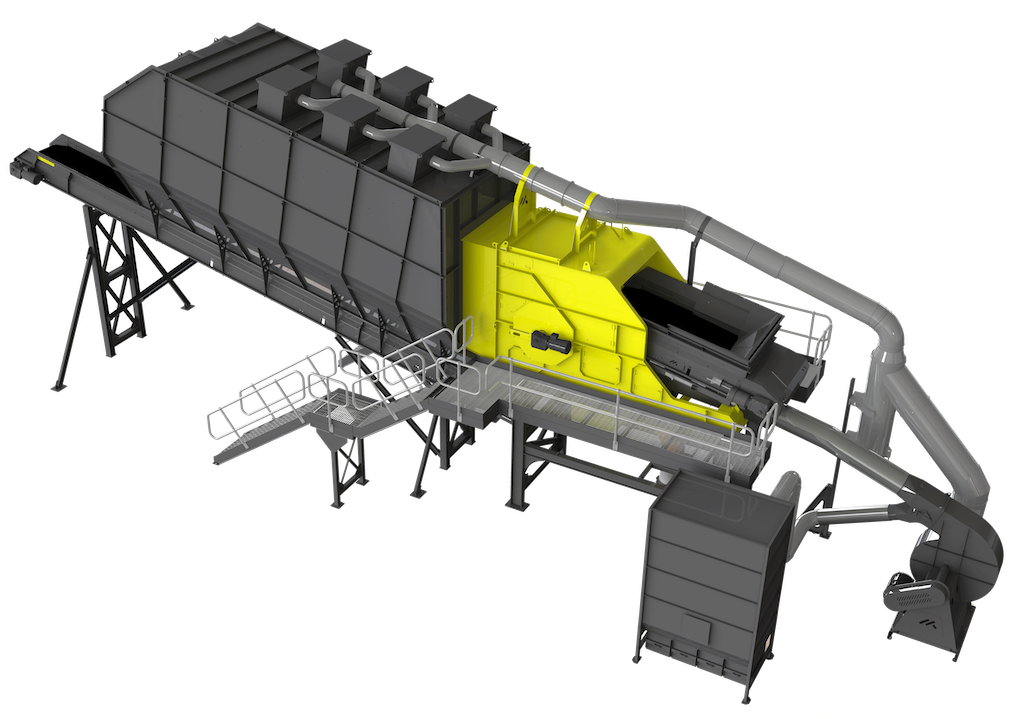
AS2VRM Single Drum Air Density Separator
separate
Separate into 2 Fractions. Heavy Density & Light Density
modular
Ready Platform. Integrates Into Any Line

2
Heavy Fraction + Light Fraction

1000-2000MM
Sized to Your Throughput
AS2VRM — Single Drum Air Density Separator
- High-Volume, Low-Pressure
- Closed-Loop Air Recirculation
- Negative Chamber Pressure
- Built-In Dust Control
- VSD Controlled, Downward-Angled Acceleration Belt
- Modular
The M&K AS2VRM is a proven single drum air density separator/windshifter built for high-volume static recycling lines that demand clean, consistent separation and dust-controlled operation. The AS2VRM recirculates its air internally — creating negative chamber pressure, controlling dust, and reducing energy consumption. A downward-angled acceleration belt prevents heavy materials with a large surface area from being incorrectly carried into the light fraction, delivering sharper separation accuracy from the outset. Available from 1000mm to 2000mm accelerator belt widths, the AS2VRM is supplied as a standalone modular unit for direct integration into your recycling line or plant. A
How the AS2VRM Single Drum Air Density Separator Works
The AS2VRM uses a high-volume, low-pressure airstream to separate mixed waste streams into 2 clean fractions — heavy and light — as material passes over a single rotating drum. Two engineering features work together to deliver sharper separation accuracy than a conventional windshifter: a downward-angled VSD controlled acceleration belt and a closed-loop recirculating air system.
- Material feed: Mixed material is metered onto the acceleration belt at a controlled, even rate and distributed as a single layer across the full belt width. The acceleration belt is angled downward toward the separation drum. This downward angle is deliberate and important — it means that heavy materials with a disproportionately large surface area, which would otherwise be caught by the airstream despite their weight, are held against the belt by gravity and carried cleanly into the heavy fraction rather than being incorrectly lifted into the light fraction. The result is a sharper, more accurate separation from the first pass.
- Separation: As material leaves the belt and becomes airborne at the drum, a high-volume, low-pressure airstream passes through the separation chamber. Light-fraction materials — plastics, film, paper, lightweight organics — are carried by the airstream into the light-fraction discharge zone. Heavy-fraction materials — aggregates, metals, glass, dense organics — follow their natural ballistic arc and fall into the heavy-fraction discharge zone.
- Recirculation: Rather than exhausting air to atmosphere, the AS2VRM returns its air internally through a closed-loop duct system. Approximately 80% of the air is recirculated back into the separation chamber. This creates negative chamber pressure — air movement at feed and discharge openings is inward, not outward, so dust is drawn into the machine rather than expelled into the working environment.
- Filtration: The remaining 20% of air passes through an integral filter unit, capturing fine dust particles before any exhaust.
The result is clean, consistent two-fraction separation, a dust-controlled operating environment, and lower whole-life energy costs compared to open-loop windshifter designs.
The Downward-Angled Acceleration Belt — Why It Matters
One of the most common sources of separation error in air density separators is misclassification of heavy materials with a large surface area — flat wooden pieces, wide rigid plastic panels, large sheet metal offcuts. Despite being heavy, their large surface area means they can catch the airstream and be carried into the light fraction incorrectly, contaminating what should be a clean light-fraction output.
The AS2VRM addresses this directly with a downward-angled acceleration belt. Because the belt angles downward toward the separation drum, gravity acts on material during the acceleration phase — holding flat, large-surface-area heavy materials against the belt surface rather than allowing them to lift prematurely into the airstream. By the time material reaches the drum and becomes airborne, it has been correctly pre-sorted by the physics of the angled belt: genuinely light materials separate cleanly, while heavy materials with deceptive surface areas track correctly into the heavy fraction.
This is not a software adjustment or an operator setting — it is a geometric engineering feature built into every AS2VRM regardless of belt width. It works continuously and automatically on every ton of material processed.
Frequently Asked Questions
The downward-angled acceleration belt solves one of the most common separation errors in air density separation — the false classification of heavy materials with a large surface area. Flat or sheet-like heavy materials (large cardboard pieces, wide rigid plastics, flat sheet metal) can be caught by the airstream and incorrectly lifted into the light fraction despite their weight. The downward angle of the acceleration belt means gravity holds these materials against the belt surface during the acceleration phase, preventing premature lift. By the time material reaches the separation drum and becomes airborne, flat heavy materials are already correctly positioned to fall into the heavy fraction. This is a geometric engineering feature built into every AS2VRM as standard — it works automatically on every tonne processed without any operator adjustment.
The AS2VRM uses a closed-loop recirculating air system: approximately 80% of the air is returned internally, creating negative chamber pressure. Dust is drawn inward rather than expelled. . Additionally, the AS2VRM’s downward-angled acceleration belt provides sharper separation accuracy than a flat belt design by preventing false lift of large-surface-area heavy materials.
The accelerator belt width determines throughput capacity. The wider the machine, the greater the air volume required and the higher the material throughput at consistent separation quality. A 2000mm AS2VRM handles approximately twice the throughput of a 1000mm machine processing identical material. M&K offer five standard belt widths from 1000mm to 2000mm. The right width is selected at the start of a project based on your required throughput, available space, and material characteristics — M&K’s engineering team will confirm the correct size for your application.
Yes. The M in AS2VRM stands for Modular. The unit is designed as a standalone module that can be purchased and integrated into an existing or new third-party recycling line without purchasing a complete M&K system. End users can buy the AS2VRM and integrate it with their own conveyor and processing infrastructure. Plant builders and OEM integrators can specify it as a component within a bespoke system they are designing for a client. M&K provide full technical support for both routes — from specification through to commissioning.
Yes. The M in AS2VRM stands for Modular. The unit is designed as a standalone module that can be purchased and integrated into an existing or new third-party recycling line without purchasing a complete M&K system. End users can buy the AS2VRM and integrate it with their own conveyor and processing infrastructure. Plant builders and OEM integrators can specify it as a component within a bespoke system they are designing for a client. M&K provide full technical support for both routes — from specification through to commissioning.
Negative chamber pressure is created because the recirculation system draws more air out of the separation chamber than is introduced — the chamber operates below ambient atmospheric pressure.
Other Air Density Separators
Transformational Projects
Skips R Us Maximises Biomass Production Efficiency with M&K Static Trommel System
Read moreEfficient Screening of Organic Waste with M&K Trommel
Read moreAscot Bin Hire Transforms C&D Waste Processing Operations
Read moreBati Recyclage Enhances Operations with a PS212T Track Picking Station
Read moreCoopers Waste Transforms Business with M&K Recycling System
Read moreCircle Recycling Supercharges Waste Processing
Read moreCombine with
Other recycling products in M&K’s range to provide an easy, fast & hassle free ways of processing waste. #recyclingmadeeasy